
THE LSN: SWAHILI MADE EASY™ BLOG
High-Frequency Travel Vocabulary in Swahili (The Foundations-First Way)
A new student was recently planning a trip to Tanzania. She said, “I know a lot of Swahili words, but when I travel, my sentences still fall apart.”
There was nothing wrong with her effort. She has been studying and had memorized many travel words.
But in real moments, at the airport, in a taxi, at the hotel , the confidence she expected was not there.
And this is something I see often.
Many learners collect travel vocabulary, but the foundation underneath those words is still developing. So when it is time to actually speak, the words do not come together as smoothly as they hoped.
This is why, inside our Daily Swahili Anchor- (Free practice space inside the LSN: Swahili Made Easy ™ app) this month, we are focusing on travel through a foundations-first lens.
Today, I want to help you build high-frequency Swahili travel vocabulary in a way that you can actually use.
Why Travel Vocabulary Alone Is Not Enough
It is very tempting to memorize themed lists:
airport
passport
hotel
taxi
There is nothing wrong with learning the words. But real communication does not happen in isolated vocabulary. It happens in structured phrases.
For example, knowing the word:
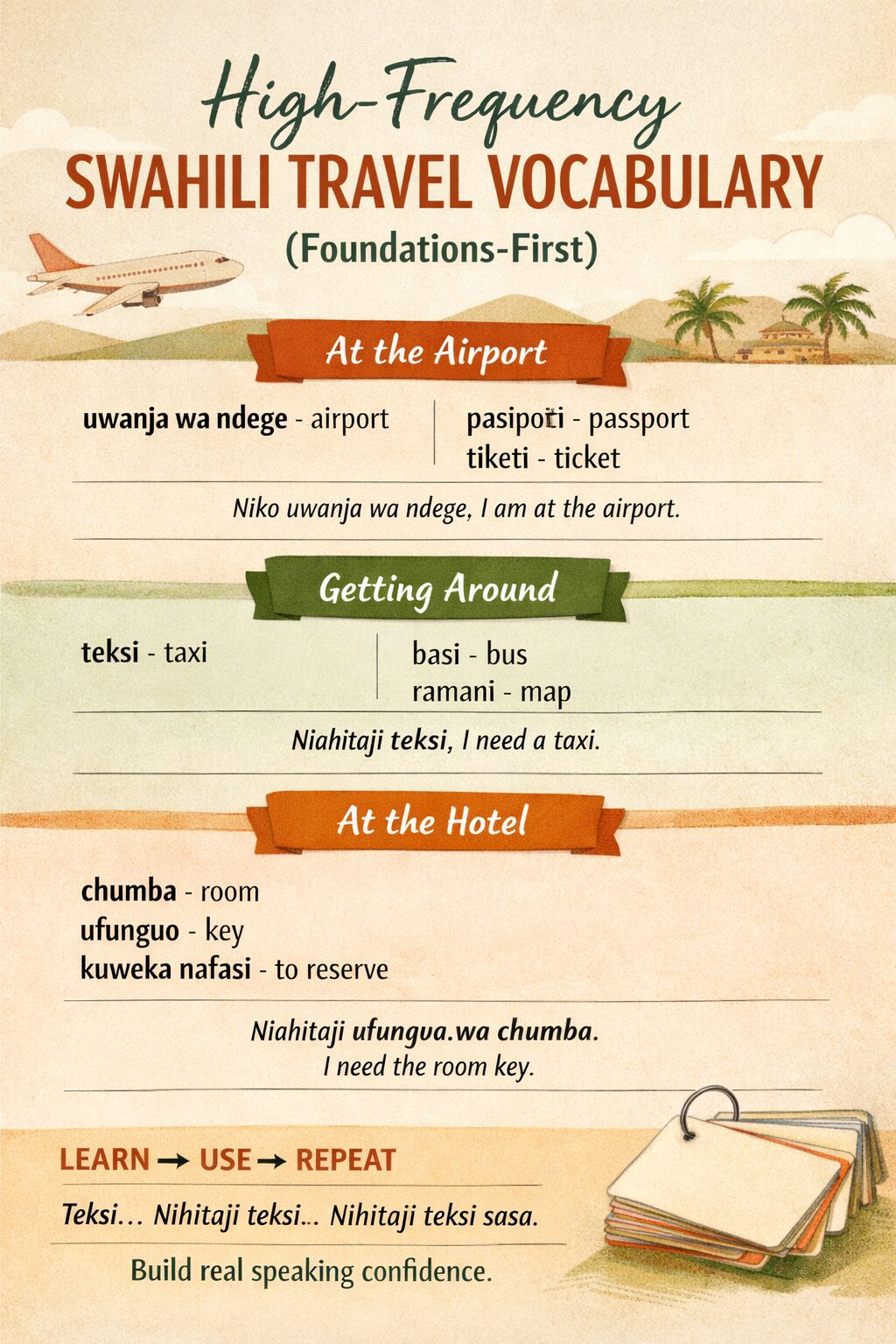
uwanja wa ndege — airport
…is helpful.
But being able to say:
Niko uwanja wa ndege.
(I am at the airport.)
That is what makes the language usable.
Foundations first always asks a simple question: can you place the word into a sentence when you need it?
High-Frequency Swahili Travel Words You Will Actually Use
Let’s begin with essential travel vocabulary that appears again and again in real situations.
At the Airport
uwanja wa ndege — airport
ndege — airplane
tiketi — ticket
pasipoti — passport
kuondoka — to depart
kuwasili — to arrive
Now let’s place a few into structure:
Nina tiketi.
(I have a ticket.)
Ndege imewasili.
(The plane has arrived.)
Getting Around
teksi — taxi
basi — bus
kituo — station
barabara — road
ramani — map
In context:
Nahitaji teksi.
(I need a taxi.)
Kituo kiko wapi?
(Where is the station?)
At the Hotel
hoteli — hotel
chumba — room
ufunguo — key
kuweka nafasi — to reserve
mapokezi — reception
In context:
Nina nafasi hotelini.
(I have a reservation at the hotel.)
Ninahitaji ufunguo wa chumba.
(I need the room key.)
The Foundations-First Way to Practice Travel Swahili
Here is where many learners unintentionally slow their progress.
They read the list.
They recognize the words.
And then they move on.
But fluency grows through structured repetition.
Inside the foundations-first approach, we practice travel vocabulary in three simple steps:
Step 1: Learn the high-frequency word
Step 2: Place it inside a simple sentence
Step 3: Repeat it aloud until it feels natural
For example:
teksi →
Ninahitaji teksi →
Ninahitaji teksi sasa.
Do you see how the structure grows? This is how the language begins to feel more natural when you need it.
Why Flashcards Help When Used Intentionally
If you are serious about remembering travel vocabulary, you need consistent, visible repetition.
This is exactly why I created the LSN Swahili Flashcards.
Not as random word collectors, but as reinforcement tools that help you see the words repeatedly, recall them faster, and place them into real sentences with more ease.
When flashcards are used consistently and paired with simple sentence practice, vocabulary moves from recognition into active use.
Building Travel Confidence One Pattern at a Time
This month inside the Daily Swahili Anchor, we are continuing to build travel confidence the foundations-first way, one small, high-frequency pattern at a time.
If you would like extra support remembering and practicing these travel terms, the LSN Swahili Flashcards were designed to make your repetition simple and structured.
You can explore the flashcards here → 🔗https://shop.learnswahilinow.com
You do not need more scattered vocabulary.
You need the right words, practiced in the right way, until speaking begins to feel steady and ready.
We will keep building from here.
Recent Posts

Mastering Swahili Fundamentals: How to Negate the Swahili Past Tense with Confidence
By Learnswahilinow |

Why Knowing Many Swahili Words Still Doesn’t Lead to Conversation
By Learnswahilinow |

Should You Quit Learning Swahili — Or Are You Just Missing the Right Support?
By Learnswahilinow |

What to Learn Next in Swahili | From Grammar to Real-Life Use
By Learnswahilinow |
What Should You Learn First in Swahili? A Clear Learning Order
By Learnswahilinow |
How to Learn Swahili Vocabulary Without Memorizing Lists
By Learnswahilinow |
© 2026 LSN: Swahili Made Easy ™. All rights reserved.