
THE LSN: SWAHILI MADE EASY™ BLOG
How Swahili Noun Classes Work (And Why Everything Finally Makes Sense)
For a long time, Spanish felt familiar to me, but not settled.
I could understand it. I could speak it. But I was often guessing. That changed when verb tenses finally clicked, not as isolated rules to memorize, but as a system. Once I understood how the tenses related to each other, Spanish became calmer and more predictable. I could anticipate what was coming next instead of reacting in the moment.
That experience mirrors what happens for most Swahili learners.
Swahili doesn’t become clear by learning more words. It becomes clear when learners finally understand noun classes — the structure holding the entire language together.
What Are Swahili Noun Classes?
Noun Classes as the Organizational System of Swahili
Swahili noun classes are a classification system that groups nouns based on shared patterns. Each noun belongs to a specific class, and that class determines how other words in the sentence behave.
Unlike English, where nouns don’t affect surrounding words very much, Swahili uses noun classes to create agreement throughout the sentence.
How Noun Classes Affect Other Words
Once a noun class is involved, it influences:
-
adjectives
-
verbs
-
possessives
-
demonstratives
This agreement is not decorative — it’s structural. It’s what gives Swahili its internal logic.
Why Swahili Feels Confusing Without Noun Classes
Memorization Without Structure
Many learners start by memorizing phrases, greetings, and common expressions. While this works temporarily, it often leads to fragile progress.
Without understanding noun classes, learners are left guessing why words keep changing.
Why “Randomness” Is Actually Missing Framework
Swahili isn’t random — it’s systematic. But when noun classes are skipped or introduced too late, learners experience the language as unpredictable.
Noun classes provide the framework that turns memorization into understanding.
Swahili Noun Classes and Demonstratives Explained
One of the first places noun classes become visible is through demonstratives — words like this, that, these, those.
What Are Demonstratives in Swahili?
Demonstratives help us point things out spatially:
-
this (near)
-
that (far)
-
that over there (very far)
English keeps these words the same regardless of the noun.
Swahili does not.
Demonstratives Must Agree With the Noun Class
In Swahili, demonstratives change form to match the noun class. Once you know the noun class, the demonstrative becomes predictable.
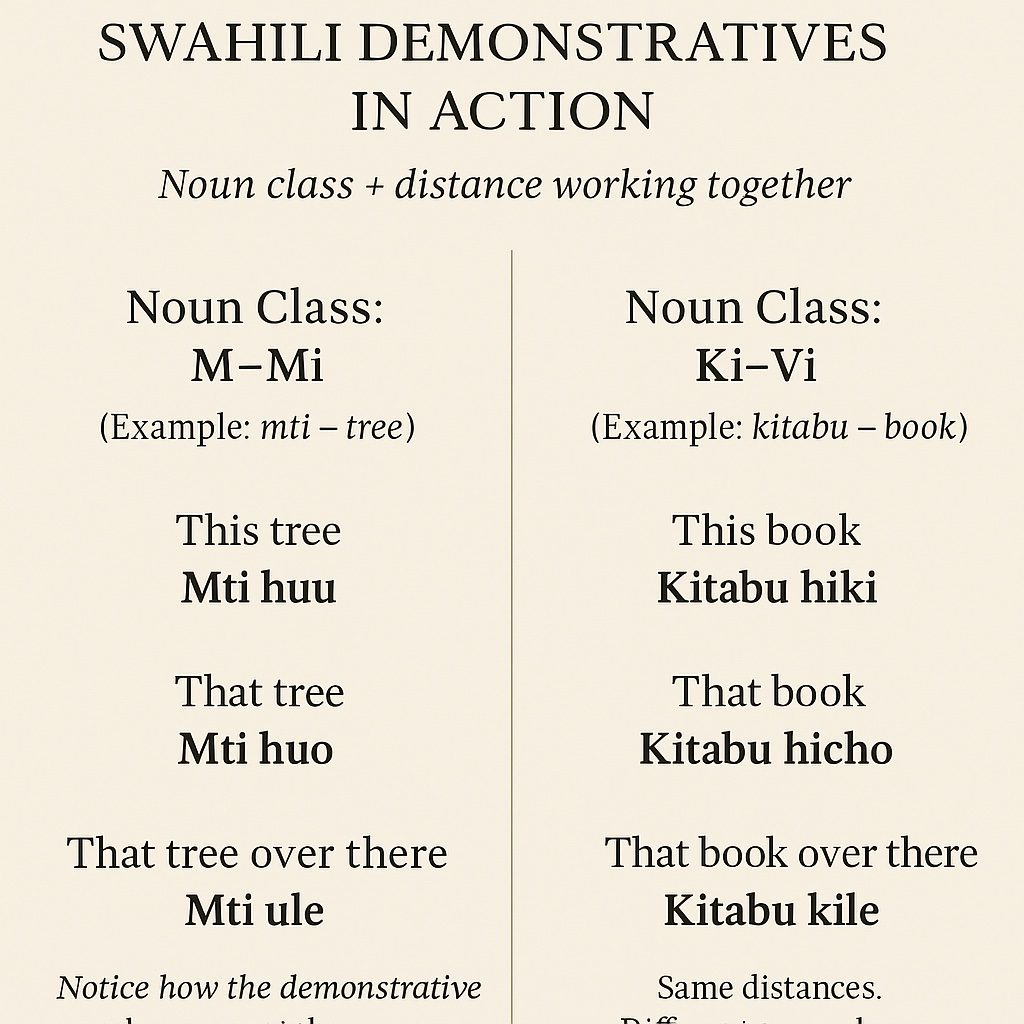
M–Mi Noun Class Demonstrative Examples
(Example: mti — tree)
-
This tree → Mti huu
-
That tree → Mti huo
-
That tree over there → Mti ule
Here, the noun mti stays the same — only the demonstrative changes.
Ki–Vi Noun Class Demonstrative Examples
(Example: kitabu — book)
-
This book → Kitabu hiki
-
That book → Kitabu hicho
-
That book over there → Kitabu kile
Same distances. Different noun class.
Same logic.
Once learners see this pattern, demonstratives stop feeling like extra vocabulary to memorize. They become expected.
This is often the moment Swahili starts to feel calm.
Why Noun Classes Create Breakthroughs in Swahili
Fluency Comes From Predictability, Not Effort
Just like verb tenses unlocked Spanish for me, noun classes unlock Swahili. Fluency doesn’t come from trying harder — it comes from knowing what to expect.
Seeing the System Changes How You Learn
When learners understand noun classes, they move from guessing to anticipating. Learning stops feeling accidental and starts feeling intentional.
How to Start Learning Swahili Noun Classes Gently
Learn One Pattern at a Time
Noun classes don’t need to be learned all at once. Progress comes from layering understanding slowly.
Focus on Agreement, Not Charts
Instead of memorizing charts, focus on how words move together.
Watch the Structure in Action
To support this, I’ve created a short introductory lesson on noun classes and demonstratives designed to help learners see the pattern in action.
Preparing for a 30-Day Noun Class Reset
Why a Gentle Reset Works Better Than Intensives
Deep language understanding doesn’t come from cramming. It comes from steady, thoughtful exposure.
Laying the Foundation Before January
This lesson is part of how we’re preparing for our Gentle 30-Day Noun Class Reset in January — building clarity now so January feels supportive, not overwhelming.
Final Thoughts on Swahili Noun Classes
Noun Classes Are the Key, Not the Obstacle
Swahili is an elegant, structured language. When learners are shown the structure early, confidence replaces confusion.
Noun classes are not a barrier to fluency — they are the doorway
Recent Posts

Mastering Swahili Fundamentals: How to Negate the Swahili Past Tense with Confidence
By Learnswahilinow |

Why Knowing Many Swahili Words Still Doesn’t Lead to Conversation
By Learnswahilinow |

Should You Quit Learning Swahili — Or Are You Just Missing the Right Support?
By Learnswahilinow |

What to Learn Next in Swahili | From Grammar to Real-Life Use
By Learnswahilinow |

What Should You Learn First in Swahili? A Clear Learning Order
By Learnswahilinow |

How to Learn Swahili Vocabulary Without Memorizing Lists
By Learnswahilinow |
© 2026 LSN: Swahili Made Easy ™. All rights reserved.