
THE LSN: SWAHILI MADE EASY® BLOG
How to Talk About Your Hobbies in Swahili Naturally
“Karen, I can introduce myself in Swahili. I can greet people. I can even answer basic questions. But the moment a conversation becomes natural, I panic.” That was how a conversation went with a Swahili learner a few years ago.
And honestly? I knew exactly what she meant.
Because what she was really saying was:
“I do not yet know how to talk about my life.”
Not textbook life.
Not classroom life.
Real life.
The things she enjoyed.
The things she did after work.
What she liked doing on weekends.
The small things that make conversations feel human.
So I simply asked her:
“What do you enjoy doing?”
At first she froze. Then slowly she answered:
“Ninapenda kusoma…”
(I like reading…)
And from there I could tell something had changed. She started to think of Swahili in practical ways; bringing together grammar, vocabulary into life.
We started talking about books. Then evening routines. Then favorite places to relax. Then music. Then cooking. Then travel. Before long, she was no longer trying to “perform” Swahili correctly. She was communicating. Imperfectly at times, yes, but naturally.
And that moment reminded me of something I see over and over again with adult learners: many people do not struggle because they are incapable of learning Swahili. They struggle because most learning methods never fully bridge the gap between vocabulary and real life.
- Why Talking About Hobbies Helps You Learn Swahili Naturally
That is why this month inside LSN, we are focusing on hobbies.
At first glance, hobbies may seem simple or even “light.” But they are actually one of the best gateways into real conversation because hobbies naturally pull learners into everyday sentence patterns.
When someone talks about hobbies, they automatically begin using:
- present tense
- future tense
- frequency words
- likes and dislikes
- descriptive vocabulary
- conversational connectors
Without even realizing it, they stop speaking in isolated words and begin speaking in connected thoughts. Over the first half of this month, in our DSA (if you do not check in daily you are really missing out) we explored different hobby-related vocabulary and expressions.
Things like:
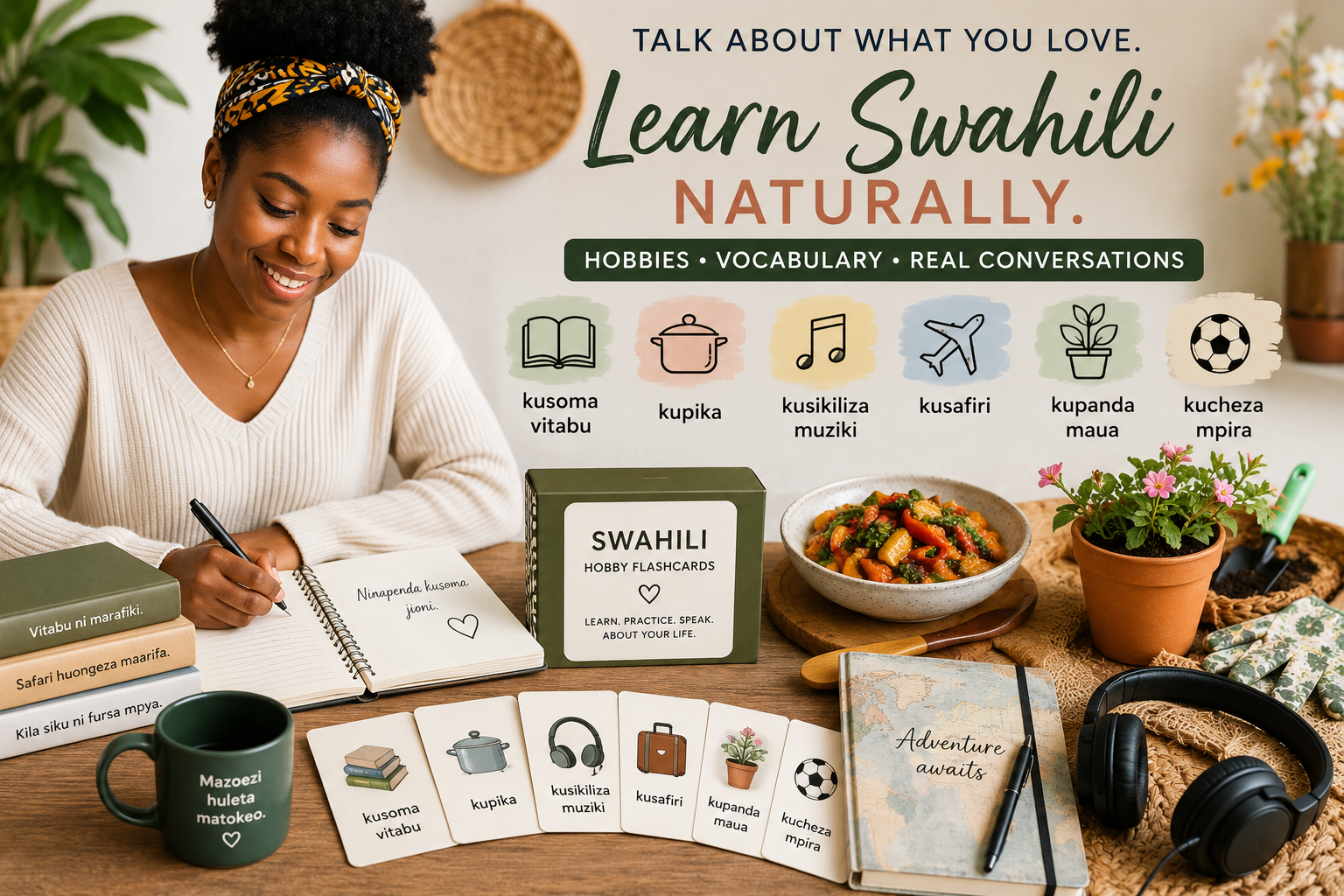
- kusoma vitabu (to read books)
- kupika (to cook)
- kuogelea (to swim)
- kusikiliza muziki (to listen to music)
- kusafiri (to travel)
- kucheza ala za muziki (to play musical instruments)
And what I love about hobby vocabulary is that learners immediately connect emotionally to it.
This is no longer random memorization.
This is identity.
You are learning how to talk about yourself.
-
How to Use Swahili Hobby Vocabulary in Real Conversations
But now, during the second half of the month, we are going deeper. Because knowing vocabulary is only the beginning. The real breakthrough comes when learners understand how to use these hobbies naturally inside conversation.
For example:
- Ninapenda kupika jioni.
(I enjoy cooking in the evening.) - Mara nyingi husikiliza muziki nikifanya kazi.
(I often listen to music while working.) - Wikendi hii tutasafiri pamoja.
(This weekend we will travel together.)
These kinds of sentences may seem small, but they represent a major shift.
The learner is no longer simply recalling information.
They are expressing thoughts.
And honestly, this is where many adult learners quietly regain confidence.
Because deep down, most frustrated learners are not tired of Swahili itself. They are tired of feeling disconnected from the language. Tired of collecting random words without knowing how to naturally bring them together.
That is why structure matters so much. Language learning should feel connected. Layered. Intentional. Each lesson should build on the previous one in a way that helps the learner slowly organize the language in their mind instead of constantly starting over. This is exactly what we do in our main courses at LSN: Swahili Made Easy®. Nothing is ever random or isolated. See an example here
One beautiful thing about Swahili is that once you learn a few conversational patterns, you can begin building many natural conversations very quickly.
For example, one common question people ask when getting to know someone is:
Unapenda kufanya nini wakati wa mapumziko?
(What do you like to do in your free time?)
You may also hear:
Unapenda kufanya nini ukiwa na muda wa ziada?
(What do you like to do when you are free?)
Once learners understand this structure, they can begin answering in many different ways using hobby vocabulary.
For example:
- Ninapenda kusoma vitabu.
(I enjoy reading books.) - Ninapenda kupika chakula kipya.
(I enjoy cooking new food.) - Ninapenda kusikiliza muziki jioni.
(I enjoy listening to music in the evening.) - Ninapenda kusafiri na marafiki wangu.
(I enjoy traveling with my friends.)
And from there, conversations begin growing naturally.
Here is a simple example of how a real beginner conversation might flow:
A: Unapenda kufanya nini wakati wa mapumziko?
(What do you like to do in your free time?)
B: Ninapenda kusoma vitabu na kusikiliza muziki. Wewe je?
(I enjoy reading books and listening to music. What about you?)
A: Mimi ninapenda kupika na kuogelea wikendi.
(I like cooking and swimming on weekends.)
B: Vizuri sana!
(Very nice!)
And honestly, this is where language learning starts becoming exciting.
Because learners are no longer simply memorizing isolated words. They are beginning to exchange ideas, express personality, and participate in real human conversation.
Another important thing learners begin noticing is how easily Swahili hobbies connect with time expressions and routines.
For example:
- kila siku = every day
- mara nyingi = often
- wikendi = on weekends
- asubuhi = in the morning
- jioni = in the evening
So instead of short disconnected sentences, learners begin creating fuller thoughts:
- Mara nyingi yeye husoma jioni.
(She/he often reads in the evening.) - Wikendi sisi hucheza mpira.
(On weekends we play soccer.) - Kila siku yeye husikiliza muziki.
(He/she listens to music every day.)
These may seem like small details, but this is exactly how learners begin sounding more natural and conversational in Swahili.
-
Swahili Flashcards That Help You Talk About Your Life
One thing that has helped many of my students bridge this gap is using flashcards differently. Not as random memorization tools, but as conversation-building tools. That is actually why I created our themed Swahili flashcards.
Instead of simply helping learners memorize isolated vocabulary, the cards are designed to help learners talk about their actual lives. Their interests. Their routines. Their personality.
Because it is one thing to memorize the word kupika.
It is another thing entirely to comfortably say:
“Ninapenda kupika chakula cha Kenya wikendi.”
(I enjoy cooking Kenyan food on weekends.)
That is where language starts becoming personal.
And honestly, that personal connection changes everything.
When learners begin seeing themselves inside the language, consistency becomes easier. Confidence grows faster. Conversations feel less forced. Swahili stops feeling like a school subject and starts feeling like a living part of their world.
So over these next two weeks in our DSA in the app (where I record new swahili phrases for you to learn every week day), we are going to continue moving beyond simply naming hobbies and begin using them naturally in conversation. We will explore how these verbs behave in real sentences, how meaning changes across contexts, and how learners can begin expressing themselves more fluidly and confidently. See the DSA
And if you want extra support practicing hobby vocabulary in a practical, everyday way, our Swahili hobby flashcards are a wonderful place to start. They are designed to help you move beyond memorization and into real-life communication one small conversation at a time.
Because the goal is not simply to know Swahili.
The goal is to comfortably talk about your life in Swahili.
Until next time,
Mwalimu Karen 💛
Recent Posts

How to Build Confidence Speaking Swahili
By Learnswahilinow |

How to Move Beyond Swahili Greetings and Keep a Conversation Going
By Learnswahilinow |

Around the House in Swahili: Essential Vocabulary for Everyday Life
By Learnswahilinow |
Why It’s So Hard to Stay Consistent Learning Swahili (And 7 Ways to Fix It)
By Learnswahilinow |
How to Talk About Weather and Seasons in Swahili
By Learnswahilinow |

Swahili for Travel: Simple Phrases That Actually Help You Connect
By Learnswahilinow |
© 2026 LSN: Swahili Made Easy®. All rights reserved.