THE LSN: SWAHILI MADE EASY™ BLOG

Kidole Kimoja Hakiui Chawa -The Lesson I Didn’t Know I Needed
🌼 I’ll start with something honest: I don’t enjoy asking for help.
I never have. I’m the type who will work too hard on something, push too long, and figure out ten different ways to solve it on my own before I finally let someone step in. And without fail, the moment support arrives, I catch myself thinking, “Why didn’t I do this sooner?”
It’s almost comical. I know better. I teach structure. I teach consistency. I teach frameworks that prevent overwhelm. And yet, there are areas where my first instinct is still: Let me handle it alone.
There’s something unique about people who lead themselves. We’re capable. We’re disciplined. We trust our own rhythm. Independence becomes our armor ; but also our blindfold. It protects us, but sometimes it keeps us from seeing easier paths right in front of us.
🌿 And this week, of all things, a simple Swahili proverb opened my eyes again:
Kidole kimoja hakiui chawa - one finger alone cannot crush a louse.
At first, it sounds like a practical observation, almost humorous. But the message beneath it is profound. Even the strongest finger, with all its effort, isn’t designed to accomplish everything alone. Some things require support, alignment, and shared strength.
As I reflected on it, I realized this is true in my personal life, in my business, and in my spiritual walk. It’s true in parenting, in marriage, in health, in self-discipline, and especially in learning. We carry so much quietly. We push ourselves because we can. But capability is not the same thing as ease. And independence, while powerful, is not the same thing as wisdom.
✨ Support doesn’t make you weaker. Support frees up your strength for the things that actually matter.
In my work with learners inside LSN: Swahili Made Easy, I see this principle unfold every day. The ones who try to do everything alone often struggle the longest. They stall, restart, question themselves, and feel guilty for not being “consistent enough.”
But the moment they ask a question…
The moment they join the community…
The moment they let the structure guide them instead of forcing everything on their own…
Everything changes. Their motivation steadies. Their confidence grows. Their progress becomes smoother, lighter, and more joyful. Because they’re no longer the only finger, they’re supported by a whole hand.
And this applies far beyond language learning.
In life, too, we are lifted when we allow ourselves to be supported.
We become gentler with ourselves.
We move with more clarity.
We create more sustainably.
We grow without burnout.
🔥 The proverb reminded me of something I want to carry into every area of my life:
Just because I can do something alone doesn’t mean I should.
Sometimes the most powerful thing you can do is open your hand and let someone else add theirs. Not to take over for you, but to join you.
So this week, I invite you to reflect on your own journey.
Where are you working too hard alone?
Where are you carrying more than you need to?
Where could support, structure, or community make your path lighter?
Because no matter how strong or independent you are, the truth remains:
Kidole kimoja hakiui chawa.
You were never meant to do everything by yourself.
And you don’t have to.
🌱 Lean into connection.
🌱 Lean into support.
🌱 Lean into community.
Your journey , in Swahili and in life, becomes richer when you don’t walk it alone.
I am rooting for you, always.
— Mwalimu Karen
✨ Ready to rebuild your rhythm?
-
🔥 Join the free Ignite Your Swahili 5-Day Challenge to restart your journey.
-
🌿 Go deeper with All Access Premium — your structured path to fluency.
Share This Post On:
Recent Posts
Sorry, we couldn't find any posts. Please try a different search.
© 2026 LSN: SWAHILI MADE EASY™. All rights reserved.
Recent Posts
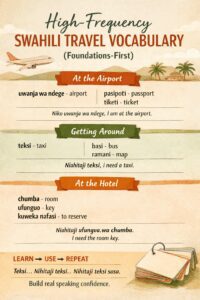
High-Frequency Travel Vocabulary in Swahili (The Foundations-First Way)
By Learnswahilinow |

Mastering Swahili Fundamentals: How to Negate the Swahili Past Tense with Confidence
By Learnswahilinow |

Why Knowing Many Swahili Words Still Doesn’t Lead to Conversation
By Learnswahilinow |

Should You Quit Learning Swahili — Or Are You Just Missing the Right Support?
By Learnswahilinow |

What to Learn Next in Swahili | From Grammar to Real-Life Use
By Learnswahilinow |
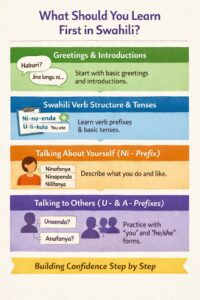
What Should You Learn First in Swahili? A Clear Learning Order
By Learnswahilinow |
© 2026 LSN: Swahili Made Easy ™. All rights reserved.