
THE LSN: SWAHILI MADE EASY™ BLOG
Swahili for Travel: Simple Phrases That Actually Help You Connect.

You’ve just landed.
You step out of the airport, take in the air, and make your way to your hotel. At the front desk, someone looks up, smiles, and greets you.
You recognize the moment.
This is where language becomes real.
You’ve learned a few words before. You may even remember some phrases. But now, standing there, you’re not thinking about vocabulary lists.
You’re thinking:
What do I actually say?
Do you greet them in Swahili?
Do you switch to English?
Do you try, even if you’re not sure?
This is the moment most learners are preparing for—whether they realize it or not.
And the truth is, you don’t need a lot to handle it well.
You need a few phrases that work.
You need enough clarity to respond.
And you need the confidence to use what you already know.
If you’ve been building your foundation, this is where it starts to come together.
If you want to strengthen that base, you can revisit this:
[Essential Swahili Words You Need When Traveling]
And if you’re still working through how the language connects, this will help:
[Swahili Foundations: How the Language Actually Works]
Now let’s walk through what you’ll actually use—step by step.
1. How to Greet Someone in Swahili
Q: How do I greet someone politely?
- Hujambo → Hello
- Sijambo →I am okay.
- Habari? → How are you?
- Nzuri → I’m fine
A greeting sets the tone.
Even a simple “Habari?” shows awareness. It shifts the interaction immediately.
2. How to Ask for Help
Q: How do I ask for help?
- Tafadhali → Please
- Naomba msaada → I am asking for help
- Unaweza kunisaidia? → Can you help me?
You don’t need perfect structure to be understood.
Clarity and intention carry more weight than perfection.
3. How to Ask for Directions
Q: How do I ask where something is?
- Wapi…? → Where is…?
- Choo kiko wapi? → Where is the bathroom?
- Hoteli iko wapi? → Where is the hotel?
Once you understand “wapi”, you begin to build your own questions.
This is where things start to connect.
4. How to Order Food
Q: How do I order something?
- Nataka… → I want…
- Ningependa… → I would like…
If you want one phrase that consistently works, use “Ningependa…”
It’s polite, clear, and fits almost any situation.
5. How to Say Thank You
Q: How do I say thank you?
- Asante → Thank you
- Asante sana → Thank you very much
Gratitude completes the interaction.
Try This
Pause for a moment.
You’ve just arrived at your hotel.
How would you:
- greet the receptionist
- ask for help
- ask where your room is
Say it out loud.
This is how language becomes usable.
If You’re Ready for Things to Make Sense
What you experienced here was not just vocabulary.
It was structure.
Each phrase had a place. Each example had a purpose.
That’s what changes how you learn.
If you want to build your Swahili in a way that actually connects—step by step—you can continue inside All Access.
👉 This is where you move from isolated phrases to clear, structured learning you can rely on.
If You Want to Remember What You’ve Learned
Understanding something once is not enough.
Retention comes from repetition.
If you’ve ever thought:
“I knew this yesterday, but I can’t recall it now”
That’s not failure. It’s lack of reinforcement.
👉 The flashcards give you a simple way to revisit what you’ve learned so it becomes easier to recall and use.
Even a few minutes a day makes a difference.
What Comes Next
If you noticed anything while reading this, it’s this:
You don’t need more effort.
You need better structure.
Next week, we begin a more intentional rhythm—one that helps everything connect, not just for travel, but for real conversation.
If you’ve been circling, trying to piece things together on your own—
This is where that changes.
Recent Posts
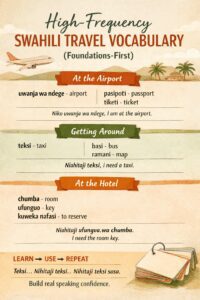
High-Frequency Travel Vocabulary in Swahili (The Foundations-First Way)
By Learnswahilinow |

Mastering Swahili Fundamentals: How to Negate the Swahili Past Tense with Confidence
By Learnswahilinow |

Why Knowing Many Swahili Words Still Doesn’t Lead to Conversation
By Learnswahilinow |

Should You Quit Learning Swahili — Or Are You Just Missing the Right Support?
By Learnswahilinow |

What to Learn Next in Swahili | From Grammar to Real-Life Use
By Learnswahilinow |
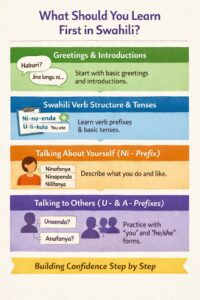
What Should You Learn First in Swahili? A Clear Learning Order
By Learnswahilinow |
© 2026 LSN: Swahili Made Easy ™. All rights reserved.