
THE LSN: SWAHILI MADE EASY™ BLOG
Swahili Noun Classes and Possessives: How -angu, -ako, and -ake Really Work
✨ If noun classes felt overwhelming at first, you are not alone, and you are not doing anything wrong. Swahili noun classes and possessives are not meant to be memorized in isolation. They are designed to work together, and once learners see that relationship, Swahili starts to feel logical instead of abstract. This is especially true when learning Swahili possessive pronouns like -angu (my), -ako (your), and -ake (his/her).
How Swahili Noun Classes Work Together (Not in Isolation)
🌿 One of the most common frustrations with Swahili grammar for beginners is the belief that noun classes are random. They are not. Noun classes create agreement across the language: affecting demonstratives, possessives, adjectives, and verbs. (If noun classes feel overwhelming, it may help to start with how Swahili noun classes work before layering in possessives.)When learners understand this system, patterns emerge and confusion fades.
Last week, we focused on noun classes and Swahili demonstratives like hiki, huyu, hawa. These words help us point to this or that. (See last week's post here) This week, we build on that same foundation by learning how possession works in Swahili.
Swahili Possessive Pronouns (-angu, -ako, -ake) Explained Simply
🌱 Here is the key idea that unlocks everything: Swahili possessive pronouns agree with the noun class, not the person. This single insight explains most of the mistakes learners make when forming possessives.
The possessive roots -angu, -ako, and -ake stay the same. What changes is the prefix, which comes from the noun class. Once you accept this rule, Swahili becomes predictable—and predictability builds confidence.
KI-VI Noun Class Example: “Kitabu Changu” Explained
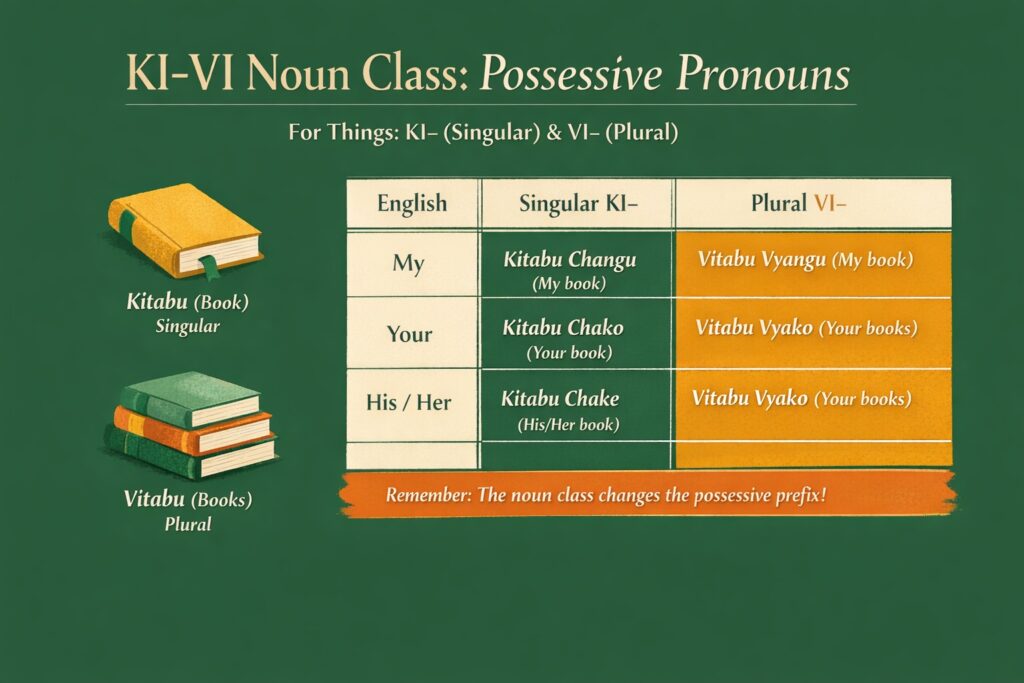
📘 Let’s look at a concrete example. The word kitabu (book) belongs to the KI-VI noun class. Because of that, you do not say kitabu yangu. Instead, you say kitabu changu.
Why? Because the KI noun class requires the ch- agreement prefix. The same pattern applies in the plural:
-
kitabu changu (my book)
-
vitabu vyangu (my books)
This same logic appears across Swahili noun classes, whether you’re talking about people, objects, or places.
Common Swahili Possessive Examples Across Noun Classes
🌿 Once you understand noun class agreement, examples like these make sense:
-
mtoto wangu (my child)
-
rafiki yako (your friend)
-
nyumba yake (his/her house)
These are not exceptions; they are the system at work.
Why Understanding Swahili Noun Class Agreement Matters
🌱 Many learners try to rush past noun classes, hoping fluency will come later. In reality, Swahili noun class agreement is what creates fluency. It allows learners to form correct sentences without guessing and helps them reuse grammar naturally in new situations.
This is why we teach noun classes slowly and intentionally inside LSN: Swahili Made Easy. We focus on patterns, repetition, and real-life usage rather than long lists and memorization.
Learn Swahili Step by Step—with Structure That Sticks
✨ If Swahili is finally starting to click for you, that is not accidental. It’s what happens when language learning respects how adults actually learn. When structure meets patience, confidence grows, and progress becomes sustainable.
✨ Want Noun Classes to Finally Make Sense?
If this post helped you see Swahili noun classes more clearly, the next step is to practice them in a focused, simple way. I created a step-by-step Noun Class Guide for learners who want clarity without overwhelm.
Inside the guide, you’ll see:
-
how noun classes actually work together
-
clear examples you can reuse in real sentences
-
patterns that make possessives, demonstratives, and agreement feel logical
👉 Get the Swahili Noun Class Guide and stop guessing.
[Download the Noun Class Guide – $9]
Recent Posts

High-Frequency Travel Vocabulary in Swahili (The Foundations-First Way)
By Learnswahilinow |

Mastering Swahili Fundamentals: How to Negate the Swahili Past Tense with Confidence
By Learnswahilinow |

Why Knowing Many Swahili Words Still Doesn’t Lead to Conversation
By Learnswahilinow |

Should You Quit Learning Swahili — Or Are You Just Missing the Right Support?
By Learnswahilinow |

What to Learn Next in Swahili | From Grammar to Real-Life Use
By Learnswahilinow |

What Should You Learn First in Swahili? A Clear Learning Order
By Learnswahilinow |
© 2026 LSN: Swahili Made Easy ™. All rights reserved.