
THE LSN: SWAHILI MADE EASY™ BLOG
How to Talk About Weather and Seasons in Swahili
If you are human, you will need to talk about the weather. If you are a human being learning another language, it goes without saying that you WILL need to learn how to talk about the weather and seasons. Nonetheless, this where as a Swahili learner you might feel an unexpected gap. You may know the word for “rain” or “sun,” but when the moment comes to say, “It looks like it will rain later,” the connection isn’t quite there. Our post today will help you learn how to navigate this very intriguing element of human small talk; not by giving you more to memorize, but by helping you see how everything fits together.
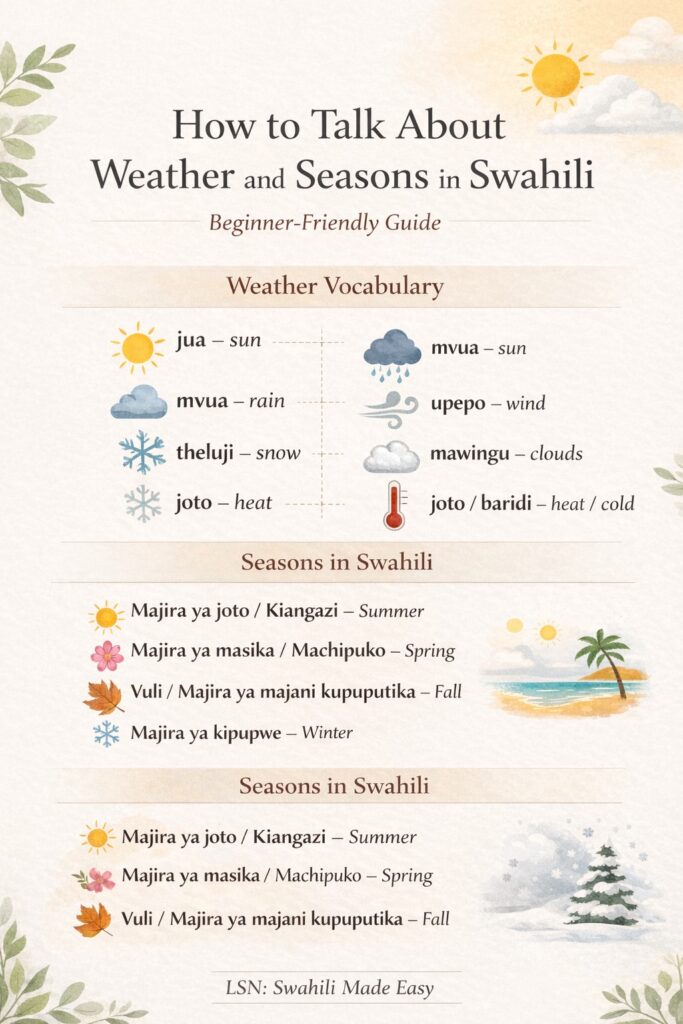
☁️Swahili Weather Vocabulary You Will Actually Use
Let’s begin with a small set of words that will carry you through most everyday conversations. These are not random, they are the ones you will naturally reach for:
- jua – sun
- mvua – rain
- upepo – wind
- baridi – cold
- joto – heat
- theluji – snow
- mawingu – clouds
- hali ya hewa – weather
Now here is where it starts to feel different. Instead of holding these as isolated meanings, you begin to form simple observations:
- Kuna jua leo. (It’s sunny today)
- Kuna baridi kali. (It’s very cold)
- Kuna theluji. (It’s snowing)
- Kuna upepo mwingi. (It’s very windy)
You might notice how natural this structure feels. “Kuna…” (there is/there are) becomes your anchor. With just this one pattern, you can already describe what you see outside your window.
🌍 How to Talk About Seasons in Swahili (In a Way That Makes Sense)
Now, let’s build on that foundation. Because if you live in the north, seasons shape your daily life—and your language should reflect that.
In Swahili, you will often hear two expressions used interchangeably:
- majira ya…
- msimu wa…
Both mean “season of…” and can be used naturally in conversation.
Here are the seasons you will want to recognize and use:
- Majira ya joto / kiangazi – summer
- Majira ya kipupwe – winter
- Majira ya masika / machipuko – spring
- Vuli / majira ya majani kupuputika – fall (autumn)
There is something beautiful here. You are not limited to one rigid term—you have options, and those options reflect both language and culture.
🌦️ What Each Season Feels Like (And How to Say It)
Now we bring everything together in a way that mirrors your lived experience. Because language sticks when it connects to what you already know.
☀️ Summer (Majira ya joto / Kiangazi)
Summer is often bright and intense:
- Kuna jua kali na joto. (It’s sunny and hot)
- Kuna mvua kidogo. (There is little rain)
🌸 Spring (Majira ya masika / Machipuko)
Spring carries change and unpredictability:
- Kuna mvua nyingi na mawingu. (There is a lot of rain and clouds)
- Hali ya hewa hubadilika mara kwa mara. (The weather changes often)
🍂 Fall (Vuli / Majira ya majani kupuputika)
Fall feels like a transition:
- Kuna upepo na baridi inaanza. (It’s windy and the cold is beginning)
- Majani yanaanguka. (Leaves are falling)
❄️ Winter (Majira ya kipupwe)
Winter brings stillness and intensity:
- Kuna baridi kali na theluji. (It’s very cold and snowy)
- Jua ni hafifu. (The sun is weak)
What you are doing here is subtle but important—you are learning to describe patterns, not just label things.
✍🏾 A Short Reading (Take Your Time With This)
Now I want you to slow down and simply read. No pressure to understand everything, just notice what feels familiar.
Swahili:
Leo hali ya hewa ni ya baridi. Kuna mawingu mengi na upepo mkali. Inaonekana kama mvua itanyesha baadaye. Asubuhi kulikuwa na jua kidogo, lakini sasa hakuna jua.
English:
Today the weather is cold. There are many clouds and strong winds. It looks like it will rain later. In the morning there was a little sun, but now there is no sun.
If you recognized even part of this, that is meaningful progress. This is how comprehension builds—quietly, over time.
🌱 How to Start Using This Today
You do not need a new routine. You simply need a small shift in awareness.
Tomorrow morning, pause for just a moment and describe what you see:
- Leo kuna baridi.
- Kuna jua leo.
- Inaonekana kama mvua itanyesha.
One sentence. That is enough. Because consistency not intensity is what creates fluency.
A Simple Way to Reinforce What You Just Learned
If you want to make this stick, come back to these words throughout the week. Write them down. Say them out loud. Notice them in your day.
And if you would like a more structured way to revisit and retain this vocabulary, you can explore the LSN: Swahili Made Easy vocabulary and flashcards, where these same words are reinforced in a way that helps them stay with you, without overwhelm.
Take your time with this. Let it feel natural. You are not chasing fluency—you are building it, one real moment at a time.
Recent Posts

Swahili for Travel: Simple Phrases That Actually Help You Connect
By Learnswahilinow |

High-Frequency Travel Vocabulary in Swahili (The Foundations-First Way)
By Learnswahilinow |

Mastering Swahili Fundamentals: How to Negate the Swahili Past Tense with Confidence
By Learnswahilinow |

Why Knowing Many Swahili Words Still Doesn’t Lead to Conversation
By Learnswahilinow |

Should You Quit Learning Swahili — Or Are You Just Missing the Right Support?
By Learnswahilinow |

What to Learn Next in Swahili | From Grammar to Real-Life Use
By Learnswahilinow |
© 2026 LSN: Swahili Made Easy ™. All rights reserved.