
THE LSN: SWAHILI MADE EASY™ BLOG
Picture this: You've just landed in Nairobi, excited to use the Swahili phrases you memorized on the plane. You confidently greet the taxi driver with "Jambo!" and... he immediately switches to English. Sound familiar?
As a linguistics expert who's helped hundreds of professionals master Swahili, I see the same mistakes over and over. These aren't just pronunciation slip-ups, they're dead giveaways that you're a tourist, not someone who truly understands East African culture.
The good news? These mistakes are completely fixable. In fact, once you understand WHY locals cringe at certain phrases, you'll not only sound more authentic, you'll connect with people on a deeper level.
Today, I'm sharing the 3 biggest Swahili mistakes that instantly mark you as a tourist, plus the simple fixes that'll have locals asking where you learned such good Swahili.
Mistake #1: The "Jambo" Dead Giveaway
The Problem:
If there's one word that screams "I learned Swahili from a guidebook," it's "Jambo."
While technically correct, using "Jambo" as your go-to greeting is like walking around New York saying "Howdy, partner!" it's not wrong, but it's definitely not local.
Why This Happens: Most Swahili learning materials teach "Jambo" because it's simple and recognizable. Tourism materials especially love it because it's easy for visitors to remember. But here's what they don't tell you: actual Swahili speakers rarely use it in daily conversation.
The Fix:
With friends/peers: Use "Mambo" (What's up?) - Response: "Poa" (Cool/Good)
Formal situations: Use "Hujambo" (How are you?) - Response: "Sijambo" (I'm fine)
Time-specific: "Habari za asubuhi" (Good morning news) or "Habari za jioni" (Good evening news)
Cultural Context: Understanding greetings in Swahili culture is about relationship-building. The back-and-forth of "Hujambo/Sijambo" creates connection. When you skip straight to "Jambo," you're missing this cultural dance that locals value.
Practice Tip: Next time you greet someone, try: "Hujambo, habari?" (How are you, what's the news?) This shows you understand that Swahili greetings are conversations, not just single words.
Mistake #2: English Vowel Contamination
The Problem: English speakers often apply their native vowel sounds to Swahili words, creating pronunciation that sounds "off" to native speakers. This is especially problematic because Swahili has pure, consistent vowel sounds.
Why This Happens: English has complex vowel systems with diphthongs and variations. We're used to vowels changing sounds based on context. Swahili vowels, however, are beautifully consistent, each one has exactly one sound.
The Fix: Master the 5 pure Swahili vowels:
A = "ah" (like "father") - NOT "ay" like "cake"
E = "eh" (like "bed") - NOT "ee" like "see"
I = "ee" (like "see") - Always long and pure
O = "oh" (like "more") - NOT "ow" like "how"
U = "oo" (like "moon") - NOT "uh" like "but"
Common Examples:
❌ "Kah-ree-boo" (English style) ✅ "Kah-ree-boo" with pure vowels (Karibu - Welcome)
Practice Exercise: Say these words focusing on pure vowel sounds:
Asante (ah-sahn-teh) - Thank you
Pole (poh-leh) - Sorry
Mzuri (m-zoo-ree) - Good/Beautiful
Pro Tip: Record yourself saying Swahili words, then compare to native speaker audio. The difference in vowel purity will be immediately obvious.
Mistake #3: Ignoring Noun Classes (The Grammar Game-Changer)
The Problem: This is the big one , the mistake that separates beginners from intermediate speakers. Swahili has noun classes that affect how adjectives, verbs, and other words change. Ignoring this system makes your Swahili sound choppy and unnatural.
Why This Happens: Noun classes are complex, and many learning resources skip them or oversimplify them. English doesn't have this system, so it feels foreign and overwhelming. But here's the truth: mastering even basic noun class concepts will dramatically improve how natural you sound.
The Fix - Start With These Basics:
M-/Wa- Class (People):
Mtu mzuri (one good person)
Watu wazuri (good people) Notice how "mzuri" becomes "wazuri" when talking about multiple people.
Ki-/Vi- Class (Things):
Kitu kizuri (one good thing)
Vitu vizuri (good things) The adjective changes to match!
Common Mistakes:
❌ "Mtu vizuri" (mixing classes) ✅ "Mtu mzuri" (person class agreement)
Why This Matters: When you get noun classes right, locals notice. It shows you understand that Swahili isn't just English with different words, it's a completely different way of organizing language and thought.
Start Small Strategy: Don't try to memorize all noun classes at once. Pick one class (I recommend M-/Wa- for people) and practice until it becomes automatic. Then add another.
Real-World Impact: I had a student who was struggling to be taken seriously in business meetings in Tanzania. Once she mastered basic noun class agreement, colleagues started including her more in discussions. The difference was that dramatic.
Your Next Steps: From Tourist to Local
These three mistakes might seem small, but fixing them creates a compound effect. When you greet people appropriately, pronounce words clearly, and show grammatical awareness, locals respond differently. They're more patient, more willing to help, and more likely to include you in authentic cultural experiences.
Ready to Sound Like a Local?
If you're serious about moving beyond tourist-level Swahili, I've created a FREE 5-day challenge called "Ignite Your Swahili" that addresses these exact issues.
You'll get:
✅ Daily pronunciation practice with pure vowel training
✅ Cultural context for greetings and common phrases
✅ Introduction to noun classes that actually makes sense
✅ Speaking confidence exercises
✅ Direct feedback from me
[CTA Button: Get Your FREE 5-Day Challenge]
After the challenge, if you want to continue your journey to 15-minute conversations in just 21 days, check out my "Beyond Ignite" program. But start with the free challenge – it'll give you a solid foundation and show you exactly what's possible when you learn Swahili the right way.
What's your biggest Swahili challenge right now? Drop a comment below – I read and respond to every one!
Share This Post On:
Recent Posts
Sorry, we couldn't find any posts. Please try a different search.
© 2026Learn Swahili Now. All rights reserved.
Recent Posts
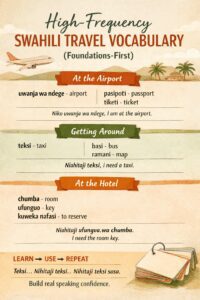
High-Frequency Travel Vocabulary in Swahili (The Foundations-First Way)
By Learnswahilinow |

Mastering Swahili Fundamentals: How to Negate the Swahili Past Tense with Confidence
By Learnswahilinow |

Why Knowing Many Swahili Words Still Doesn’t Lead to Conversation
By Learnswahilinow |

Should You Quit Learning Swahili — Or Are You Just Missing the Right Support?
By Learnswahilinow |

What to Learn Next in Swahili | From Grammar to Real-Life Use
By Learnswahilinow |
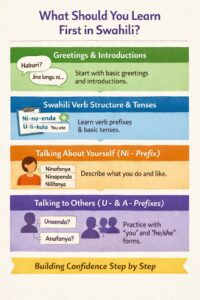
What Should You Learn First in Swahili? A Clear Learning Order
By Learnswahilinow |
© 2026 LSN: Swahili Made Easy ™. All rights reserved.