
THE LSN: SWAHILI MADE EASY™ BLOG
How to Learn Swahili Vocabulary Without Memorizing Lists
If you’ve ever sat down determined to memorize ten new Swahili words, only to forget most of them an hour later, you’re not alone. This is one of the most common frustrations learners experience — and it’s not a lack of discipline or intelligence.
The issue is how vocabulary is being learned.
Most people are taught to treat vocabulary as isolated items: a word, its meaning, and maybe a quick repetition. That approach feels productive in the moment, but it rarely leads to usable language.
There is a better way to learn Swahili vocabulary — one that works with your brain instead of against it.
Why Memorizing Swahili Vocabulary Lists Doesn’t Work
Imagine this scenario.
You sit down with good intentions and decide, “Today I’m going to learn ten new Swahili words.” You read them. You repeat them. You might even close your eyes and say them out loud, hoping they’ll stick.
Forty-five minutes later, if someone asked you to use those words in a sentence, your mind would likely go blank.
This happens because the brain does not store isolated information very well. When words are learned without context, pattern, or purpose, the brain has no reason to retrieve them later. The words feel familiar for a short time, then quietly disappear.
This is why vocabulary memorization often leads to recognition — “I’ve seen this word before” — but not confident use.
A Better Way to Learn Swahili Vocabulary: Clusters, Not Lists.
Vocabulary becomes usable when it is learned in clusters — groups of words that naturally belong together and fit into sentences you already use in daily life.
Instead of asking:
How many new words can I memorize today?
Try asking:
What do I already say every day in English — and how can I replace parts of that with Swahili?
This shift changes everything.
Learning Swahili Vocabulary Through Sentence Patterns such as Swahili Daily vocabulary
Let’s look at a simple example using daily activities.
In English, you might regularly say:
-
I am eating breakfast.
-
I am drinking coffee.
-
I am cooking dinner.
Notice that the sentence structure stays the same. Only the action changes.
In Swahili, you can practice the same pattern:
-
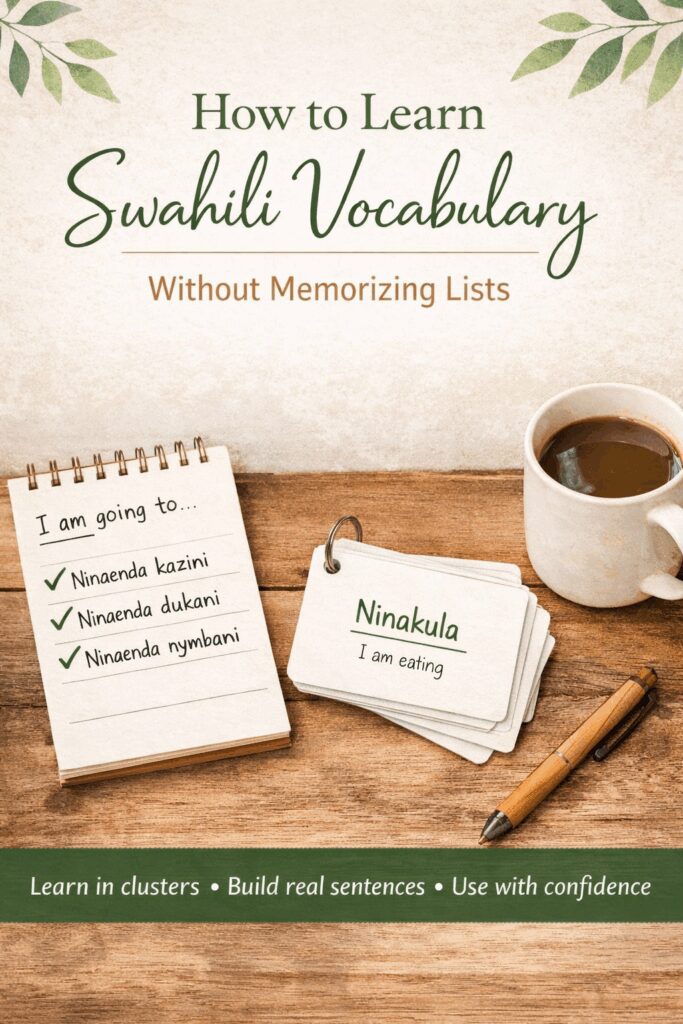
Ninakula – I am eating
-
Ninakunywa – I am drinking
-
Ninapika – I am cooking
You are not memorizing three unrelated verbs. You are practicing one sentence frame and swapping in related actions. This is a vocabulary cluster.
Because the structure stays familiar, your brain knows where each word belongs. Word of caution, it IS important to have the basic fundamentals of Swahili down before learning more vocabulary. If you do not, it could cost you your progress. (See this article to learn more about mastering the foundation).
Learn Swahili words in context; using Vocabulary Clusters for Places You Go
Another effective cluster is movement and location.
In English, you might say:
-
I am going to work.
-
I am going to the store.
-
I am going home.
In Swahili:
-
Ninaenda kazini
-
Ninaenda dukani
-
Ninaenda nyumbani
Again, the structure stays the same. Only the destination changes.
This approach allows you to practice multiple vocabulary words without overloading your brain. The meaning is clear, the pattern is stable, and repetition happens naturally.
Why This Method Helps Vocabulary Stick
When vocabulary is learned in clusters:
-
Words are connected to meaning and use
-
Patterns repeat across sentences
-
Retrieval becomes easier and faster
Instead of thinking, “What does this word mean?” you begin thinking, “Where does this word fit?”
This is the difference between memorizing vocabulary and building language.
A Simple Daily Practice for Learning Swahili Vocabulary
Here’s a practical way to use this method without overwhelm:
-
Choose one daily activity (eating, working, shopping, commuting).
-
Write or say three to five sentences you already use in English.
-
Replace only the key words with Swahili.
-
Practice those same sentences over several days.
You don’t need new sentences every day. Repetition inside a familiar structure is what builds confidence.
This may feel slower than memorization — but it leads to far better retention and real-world use.
Swahili vocabulary retention with structure and Support
If vocabulary has felt frustrating or slippery in the past, it’s rarely because you weren’t trying hard enough. It’s usually because the learning lacked structure.
When vocabulary is organized by context, routine, and meaning, it stops feeling random and starts to feel manageable.
That’s why our LSN Swahili Flashcards are designed around practical clusters — actions, routines, places, and real-life situations — rather than disconnected word lists. They’re meant to support use, not memorization.
Final Thought: Vocabulary Is Not About Collecting Words
Learning Swahili vocabulary isn’t about how many words you know. It’s about how easily you can reach the words you need.
When vocabulary is learned through clusters and sentence patterns, your brain knows where to find it — and confidence grows naturally.
Looking for a simple, structured way to practice Swahili vocabulary?
Our Swahili Flashcards are designed to help you learn words in context, build usable sentence patterns, and practice without overwhelm. CHECK THEM OUT HERE
Recent Posts
High-Frequency Travel Vocabulary in Swahili (The Foundations-First Way)
By Learnswahilinow |

Mastering Swahili Fundamentals: How to Negate the Swahili Past Tense with Confidence
By Learnswahilinow |

Why Knowing Many Swahili Words Still Doesn’t Lead to Conversation
By Learnswahilinow |

Should You Quit Learning Swahili — Or Are You Just Missing the Right Support?
By Learnswahilinow |

What to Learn Next in Swahili | From Grammar to Real-Life Use
By Learnswahilinow |
What Should You Learn First in Swahili? A Clear Learning Order
By Learnswahilinow |
© 2026 LSN: Swahili Made Easy ™. All rights reserved.