
THE LSN: SWAHILI MADE EASY® BLOG
The Mistake I Made Trying to Learn Too Fast — and How Swahili Mastery Really Works
When I was little, I really wanted to learn how to braid hair. I could kind of do it — the hair would eventually come together — but it was never neat, and I was very slow. What stood out to me was how fast everyone else seemed. Their hands moved confidently and effortlessly, while mine felt awkward and unsure.
Instead of slowing down and learning how to do it properly, I focused on trying to go faster. I assumed speed would come first, and everything else would fall into place.
That was the mistake.
I skipped the basics. I never learned finger placement, how to keep even tension, or how to separate sections cleanly. And because I never built those foundations, speed never came. To this day, I still can’t braid hair to save my life — not because I wasn’t capable, but because I learned around the basics instead of through them.
I see this same pattern all the time in Swahili language learning.
Why Learning Swahili Feels Hard Without Strong Fundamentals
Many learners rush toward fluency — more vocabulary, more phrases, more content — hoping confidence will show up later. But when fundamentals are missing, learning feels scattered. You may recognize words, but you don’t trust yourself to build sentences. You may understand rules in theory, but not know how to apply them in real conversation.
Progress feels slow, even when effort is high.
This isn’t a personal failure. It’s usually a structural one.
Swahili Sentence Structure: Why Knowing the Framework Matters
Before fluency, learners need to understand how Swahili sentences are built, not just memorized.
Take this basic sentence:
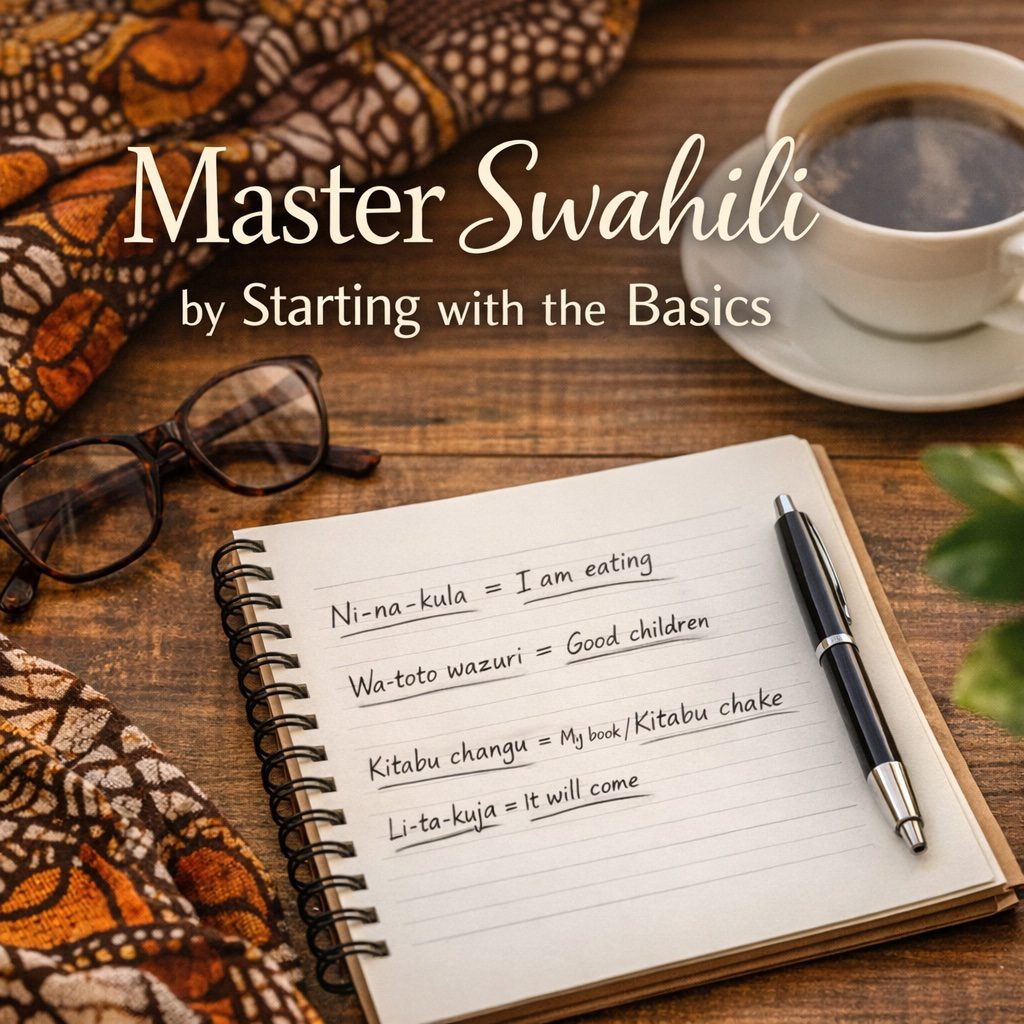
Ninakula chakula.
I am eating food.
This works because Swahili follows a clear internal structure:
Subject marker + tense marker + verb root
Now watch what happens when we change tense:
Nilikula chakula. – I ate food.
Nitakula chakula. – I will eat food.
The meaning changes because the tense marker inside the verb changes.
When learners don’t understand this structure, they often try to change time by guessing or adding extra words. They may know vocabulary, but they don’t know where meaning actually lives in the sentence. That’s why speaking feels risky and uncertain.
Once sentence structure is clear, learners can change tense confidently — without starting over each time.
Why Swahili Noun Classes Must Come Before Vocabulary Lists
Swahili is a noun-driven language. Nouns determine how adjectives, verbs, and possession behave. When learners skip noun classes and jump straight into vocabulary, the language feels inconsistent — when in reality, it’s highly logical.
For example:
mtoto mzuri – a good child
watoto wazuri – good children
If you don’t understand that mtoto and watoto belong to the same noun group, the change from mzuri to wazuri feels random. Learners end up memorizing phrases instead of understanding patterns.
With noun-class clarity, one pattern unlocks hundreds of correct sentences.
Understanding Swahili Agreement Without Memorizing Charts
Agreement is one of the biggest sticking points for learners — especially when it’s taught as charts instead of patterns.
Compare:
kitabu kikubwa – big book
vitabu vikubwa – big books
Learners often recognize these forms but hesitate when speaking. The breakthrough happens when agreement is understood as a repeating system, not a list to memorize.
Once learners see the pattern, they begin to anticipate correct forms. That anticipation is what builds confidence.
Swahili Possession and Meaning Shifts: Why Context Matters
Small changes in Swahili carry important meaning, especially with possession.
kitabu changu – my book
kitabu chake – his/her book
Without understanding how possession agrees with the noun, learners guess — and guessing erodes confidence. With guided practice, learners stop guessing and start choosing intentionally.
This is the difference between knowing about Swahili and actually using it. (See our previous blog about noun classes here)
What Happens When Swahili Fundamentals Finally Click
This is the moment learners describe with relief:
-
“I finally understand why the verb changes.”
-
“I can hear when something sounds off.”
-
“I don’t panic when I need to change tense or possession.”
Just like braiding hair, once your fingers know where to go, speed follows naturally. You don’t force it. It arrives because the foundation is stable.
Why Going Back to Swahili Basics Is a Strategic Move
If you’ve tried apps, videos, or tutors and still feel stuck, effort probably wasn’t the problem. Structure was.
Going back to fundamentals isn’t starting over. It’s choosing a clearer path forward — one that replaces guessing with understanding. However, if motivation to learn is the issue, checkout this article.
Mastery isn’t about rushing ahead.
It’s about doing the basics well, so everything that comes next feels lighter.
Ready to rebuild your Swahili foundations with clarity and support?
Beyond Ignite is a focused 3-week program designed to help you master Swahili fundamentals step by step — without overwhelm and without guessing.
Recent Posts

How to Build Confidence Speaking Swahili
By Learnswahilinow |

How to Move Beyond Swahili Greetings and Keep a Conversation Going
By Learnswahilinow |

Around the House in Swahili: Essential Vocabulary for Everyday Life
By Learnswahilinow |

How to Talk About Your Hobbies in Swahili Naturally
By Learnswahilinow |
Why It’s So Hard to Stay Consistent Learning Swahili (And 7 Ways to Fix It)
By Learnswahilinow |

How to Talk About Weather and Seasons in Swahili
By Learnswahilinow |
© 2026 LSN: Swahili Made Easy®. All rights reserved.