
THE LSN: SWAHILI MADE EASY™ BLOG
Mastering Swahili Fundamentals: How to Negate the Past Tense with Confidence
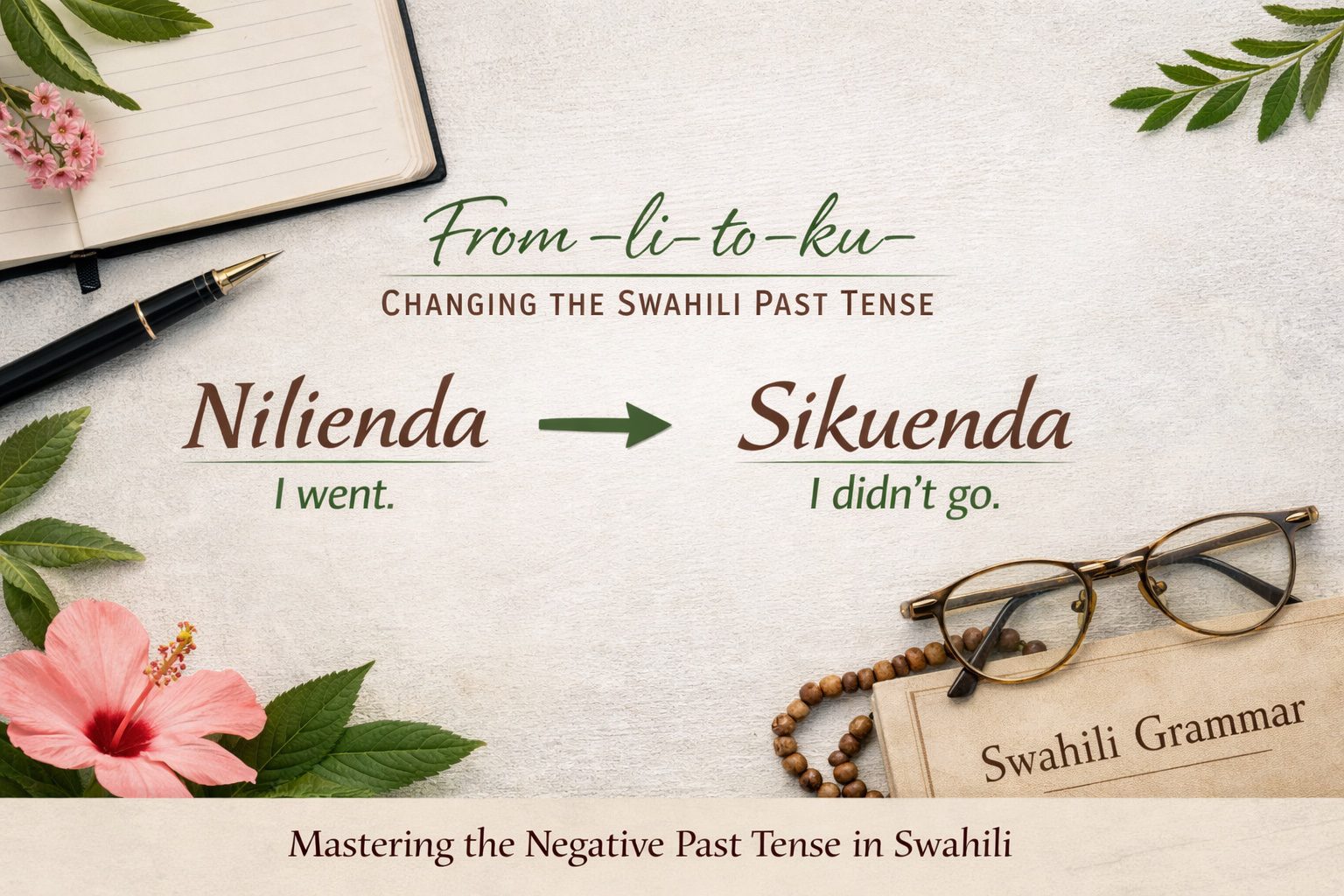
A student once told me, “I was doing well in the conversation… until I needed to say I didn’t go.”
She had learned her past tense. She could say “Nilienda” without hesitation. But the moment she needed the negative form, everything paused.
Not because she lacked effort.
Not because she had not studied.
But because she had only practiced one side of the structure.
This is why mastering Swahili fundamentals matters.
As I explained in my earlier article on why mastering fundamentals is the foundation of fluency, real progress in Swahili does not come from collecting more vocabulary. It comes from understanding how the language behaves, and being able to move confidently between forms.
If you can say what happened, you must also be able to say what did not happen.
Today, we focus on one essential building block: how to form the negative past tense in Swahili.
Understanding the Affirmative Past Tense in Swahili
Let’s begin with what you may already know.
In the affirmative past tense, Swahili uses the marker -li- inside the verb.
Examples:
- Nilienda — I went
- Ulisoma — You read
- Alifanya kazi — He or she worked
- Tulicheza — We played
- Walikuja — They came
That small -li- carries the meaning of “already happened.” Once you recognize it, you begin to see the pattern across verbs.
But what happens when we negate the past tense in Swahili?
How to Form the Negative Past Tense in Swahili
When we move from affirmative to negative, the structure shifts.
Look carefully at the comparison:
- Nilienda → Sikuenda (I did not go)
- Ulisoma → Hukusoma (You did not read)
- Alikuja → Hakuja (He or she did not come)
- Tulicheza → Hatukucheza (We did not play)
- Walifanya → Hawakufanya (They did not do)
Here is the pattern:
- The Past Marker (-li-) Disappears
In the negative past tense, Swahili removes -li- entirely.
- A Negative Subject Marker Moves to the Front
Instead of -li-, we use negative subject markers:
- si- (I)
- hu- (you singular)
- ha- (he/she)
- hatu- (we)
- hawa- (they)
3. The Verb Stem Remains the Same
The root of the verb does not change. The structure around it adjusts.
Swahili does not stack markers carelessly. When something enters, something exits. The language maintains balance.
Alikula.
Hakula.
Say them slowly. Notice how the rhythm tightens in the negative third person. Nothing is random. The structure is architectural.
Quick Guidelines for Negating the Past Tense in Swahili
If you prefer a simple checklist:
- Remove -li- from the affirmative form.
• Add the correct negative subject marker at the beginning.
• Keep the verb root unchanged.
• Practice affirmative and negative forms side by side.
For example:
Nilikula-Sikula.
Uliandika-Hukuandika.
Aliona-Hakuona.
When you practice both forms together, your brain stops treating them as separate vocabulary items. They become one controlled structure.
Why Mastering Swahili Grammar Fundamentals Changes Everything
This lesson is not just about one grammar rule.
When you understand how the Swahili past tense works in both affirmative and negative forms, you are no longer guessing. You are operating inside a system.
This is what I mean when I talk about building Swahili from the fundamentals.
If you missed it, I recommend reading my article on mastering Swahili fundamentals and structure. It explains why fragmented learning leads to frustration, and why structure creates calm progress.
Fluency is not built by intensity. It is built by consistency with patterns.
Building These Patterns Inside Beyond Ignite
Inside the Beyond Ignite: 21 Days to Swahili Breakthrough course, we apply this exact philosophy.
We do not jump randomly between topics. We take one foundational structure at a time, affirmative, negative, question forms, and practice them in connected lessons.
You see the pattern.
You practice the pattern.
You speak with the pattern.
And slowly, confidence stops feeling fragile.
If today’s lesson helped you see Swahili more clearly, imagine practicing this way for 21 intentional days, strengthening your grammar fundamentals so speaking feels steady instead of uncertain.
You can learn more about Beyond Ignite here.
Confidence in Swahili does not come from trying harder.
It comes from mastering the fundamentals one structure at a time, until the language feels predictable in your mouth.
And this is only one pattern.
We will continue building from here.
Recent Posts

High-Frequency Travel Vocabulary in Swahili (The Foundations-First Way)
By Learnswahilinow |

Why Knowing Many Swahili Words Still Doesn’t Lead to Conversation
By Learnswahilinow |

Should You Quit Learning Swahili — Or Are You Just Missing the Right Support?
By Learnswahilinow |

What to Learn Next in Swahili | From Grammar to Real-Life Use
By Learnswahilinow |
What Should You Learn First in Swahili? A Clear Learning Order
By Learnswahilinow |

How to Learn Swahili Vocabulary Without Memorizing Lists
By Learnswahilinow |
© 2026 LSN: Swahili Made Easy ™. All rights reserved.