
THE LSN: SWAHILI MADE EASY™ BLOG
What Should You Learn First in Swahili? A Clear Order That Builds Real Confidence
If you’ve ever tried to learn Swahili and felt like things didn’t quite stick, the problem is rarely effort. Most learners are motivated, consistent, and genuinely interested.
What’s usually missing is order. When Swahili is learned out of sequence, it can feel scattered — like you’re collecting pieces of the language without knowing how they fit together. Progress feels fragile, and confidence never quite settles.
The good news? Swahili becomes much clearer when it’s taught in the right order. To dig deeper into why mastery starts with structure, you can read this article on the importance of foundational structure .
Why Learning Swahili Feels Hard When the Order Is Wrong
Many learners start with greetings, then jump straight into vocabulary, phrases, or conversation practice. While this feels productive, it often creates confusion later.
- You may recognize words, but hesitate to form your own sentences.
- You may understand examples, but struggle to apply them independently.
This happens because language builds on itself. When key foundations are skipped, everything that follows feels heavier than it should.
Learning Swahili well isn’t about learning more.
It’s about learning the right things first.
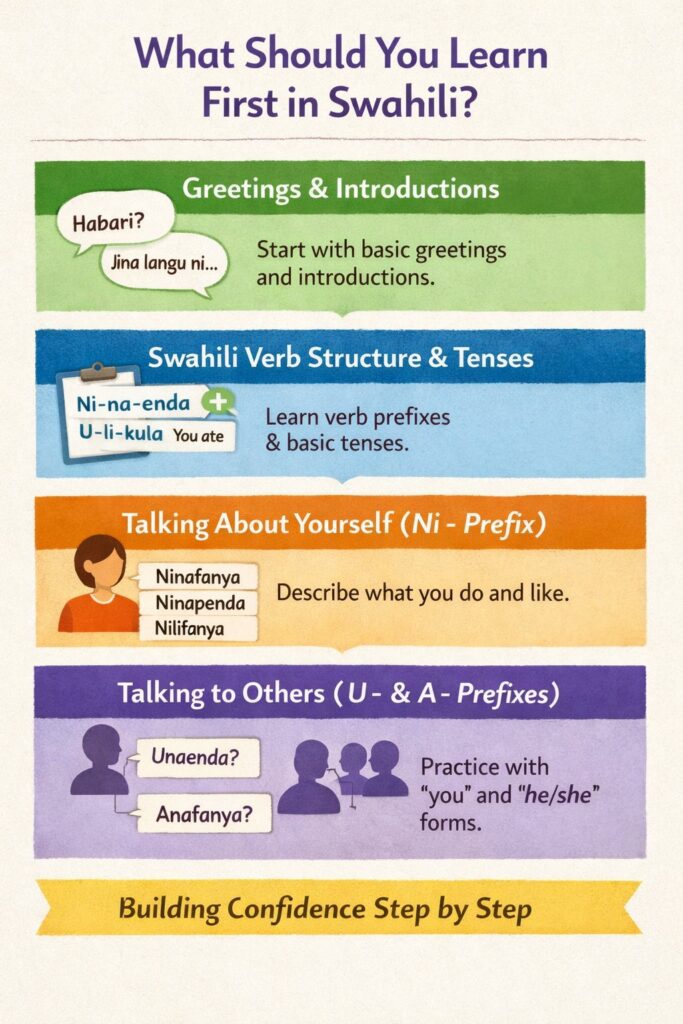
Step 1: Greetings and Introductions in Swahili
Every solid Swahili foundation begins with greetings and introductions. This stage isn’t just about memorizing polite phrases; it’s about understanding how Swahili opens conversations and establishes connection.
- greet others appropriately
- introduce themselves
- respond naturally to common exchanges
This creates early momentum without overwhelm.
Step 2: Swahili Verb Structure and Basic Tenses
After greetings, the next essential step is understanding how Swahili verbs work. Swahili expresses time inside the verb, not with extra helper words as in English.
- see where meaning lives in a sentence
- understand how time is expressed
- stop guessing when changing tense
Once this clicks, Swahili starts to feel logical instead of random.
Step 3: Talking About Yourself in Swahili (The ni- Subject Prefix)
This stage centers on the ni- subject prefix — I.
- what they do
- what they like
- what they are doing
- what they did
The language stops feeling abstract and starts feeling personal.
Step 4: Talking to Others in Swahili (The u- and a- Prefixes)
- u- for you (singular)
- a- for he/she
- and later, plural forms
Patterns repeat, confidence grows, and sentence-building becomes easier.
Final Thought:What's important,Swahili learning sequence, Not Speed
When the order is right, progress feels calmer, confidence feels steadier, and the language finally starts to make sense.
Explore our All Access program here:
Join All Access Swahili Monthly — a guided, structured path from beginner foundations to confident, usable Swahili.
Recent Posts

Swahili for Travel: Simple Phrases That Actually Help You Connect
By Learnswahilinow |

High-Frequency Travel Vocabulary in Swahili (The Foundations-First Way)
By Learnswahilinow |

Mastering Swahili Fundamentals: How to Negate the Swahili Past Tense with Confidence
By Learnswahilinow |

Why Knowing Many Swahili Words Still Doesn’t Lead to Conversation
By Learnswahilinow |

Should You Quit Learning Swahili — Or Are You Just Missing the Right Support?
By Learnswahilinow |

What to Learn Next in Swahili | From Grammar to Real-Life Use
By Learnswahilinow |
© 2026 LSN: Swahili Made Easy ™. All rights reserved.