
THE LSN: SWAHILI MADE EASY™ BLOG
Why Knowing Many Swahili Words Still Doesn’t Lead to Conversation.
Many Swahili learners reach a frustrating stage: they know a lot of vocabulary, yet speaking still feels hard. Words don’t come out naturally. Conversations feel slow or intimidating.
This isn’t because you’re doing something wrong. It’s because vocabulary alone doesn’t create conversation. A few weeks ago, I wrote a post about how to generally learn vocabulary WITHOUT memorizing (You can read it here) 🔗. This week's post focuses on how you can build vocabulary that's unique to you.
Language is not retrieved as single words. It’s retrieved through context, where you are, what you’re doing, and who you’re talking to. When words are learned in isolation, the brain struggles to access them in real-life moments. I do need to add a disclaimer. To be successful in learning and using Swahili vocabulary, it is imperative you understand how the language works. Read more about why this is important. 🔗
How to Build Vocabulary That Matches Your Real Life
Instead of asking, “What words should I learn?” a better question is:
“Where do I actually use Swahili?”
Most adults repeat the same settings every day:
-
At home
-
Running errands or shopping
-
At work or in community spaces
-
While traveling or attending appointments
Choose one setting to begin. Familiar environments make vocabulary easier to remember and easier to use.
Step 1: Choose One Setting and Stay There
Start small. One setting is enough.
For example, let’s start with home.
Step 2: Learn Nouns and Verbs That Belong Together
Vocabulary works best when words naturally appear together.
Home – Example Vocabulary
Nouns
-
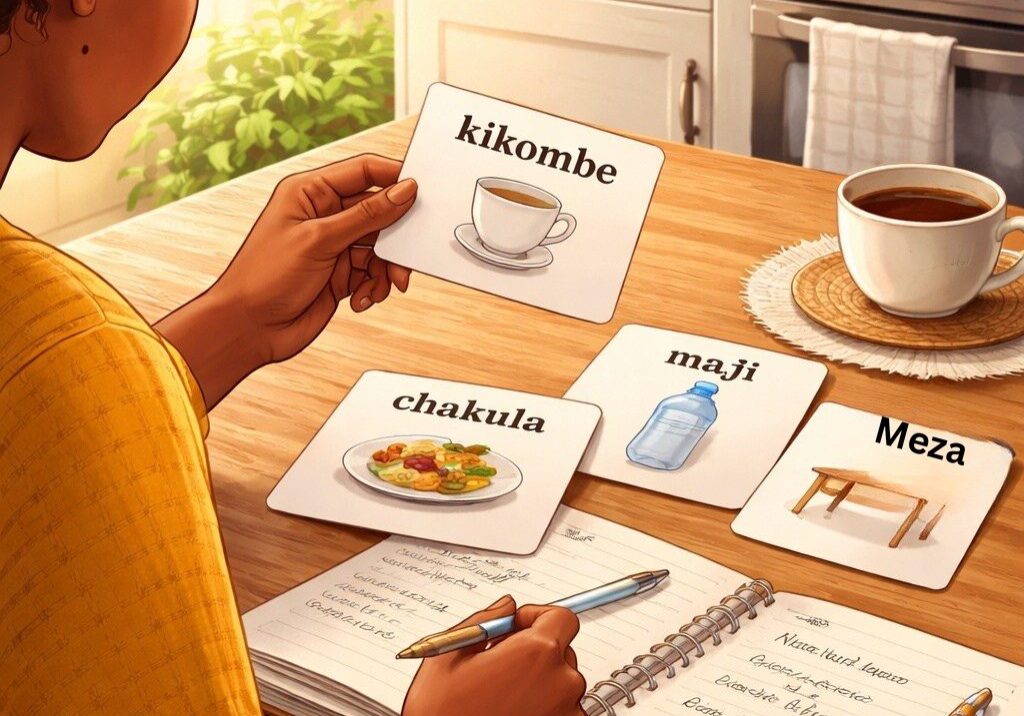
chakula – food
-
maji – water
-
kikombe – cup
-
meza – table
Verbs
-
kula – to eat
-
kunywa – to drink
-
pika – to cook
-
weka – to put
Instead of memorizing long lists, you are building a small, usable cluster of words.
This is where setting-based flashcards are helpful. When vocabulary is already organized by real-life situations, like the flashcards in our shop. Check them out 👉🏾 HERE 🔗
you remove the guesswork of what to study next.
How to Use Flashcards as Anchors (Not a Crutch)
Flashcards work best when they are close to life.
Keep your setting-specific flashcards in the space where you’ll use them:
-
Kitchen counter
-
Handbag
-
Car
-
Phone (if the setting is mobile)
As you move through the space, say what you see out loud:
-
Hiki ni kikombe. (This is a cup.)
-
Haya ni maji. (This is water.)
Then add actions:
-
Ninakunywa maji. (I am drinking water.)
-
Ninapika chakula. (I am cooking food.)
You are not studying. You are using language inside your daily routine.
Why Vocabulary Is Learned Best in Phrases, Not Single Words
Words stick when they are learned inside phrases and simple sentences.
Start with English, then gradually replace parts with Swahili:
-
“I am drinking maji.”
-
Ninakunywa maji.
This gradual replacement builds fluency without pressure and helps your brain connect meaning, structure, and sound.
Example: Building Vocabulary for Errands or Shopping
If you often shop or run errands, your vocabulary should reflect that.
Nouns
-
duka – shop
-
bei – price
-
matunda – fruit
Verbs
-
nunua – buy
-
taka – want
-
uliza – ask
Now practice sentences that actually occur:
-
Ninataka matunda. (I want fruit.)
-
Bei gani? (What price?)
-
Ninanunua ndizi. (I am buying bananas.)
Three sentences like these are more useful than dozens of disconnected words.
This is why our flashcards are organized by real-life settings, to help learners feel prepared in real situations. You can explore them HERE 🔗.
When Flashcards Naturally Fade Away
As you repeat the same setting, something shifts:
-
You stop checking
-
Words come out more easily
-
Confidence increases
At this stage, flashcards become what they were meant to be:
a brush-up tool, not something you rely on daily.
A Simple, Sustainable Way to Learn Swahili Vocabulary
You don’t need to know every word.
You need words that match your life.
One setting at a time.
One small group of words used often.
When vocabulary is learned this way, conversations stop feeling like a test, and start feeling natural.
And if you want support choosing vocabulary that already fits real life, our setting-based flashcards are always available HERE 🔗
PS. We have just expanded our settings. Now you can comfortably talk about most settings of life e.g shopping, travel, around the house et.c
Recent Posts
High-Frequency Travel Vocabulary in Swahili (The Foundations-First Way)
By Learnswahilinow |

Mastering Swahili Fundamentals: How to Negate the Swahili Past Tense with Confidence
By Learnswahilinow |

Should You Quit Learning Swahili — Or Are You Just Missing the Right Support?
By Learnswahilinow |

What to Learn Next in Swahili | From Grammar to Real-Life Use
By Learnswahilinow |
What Should You Learn First in Swahili? A Clear Learning Order
By Learnswahilinow |
How to Learn Swahili Vocabulary Without Memorizing Lists
By Learnswahilinow |
© 2026 LSN: Swahili Made Easy ™. All rights reserved.